
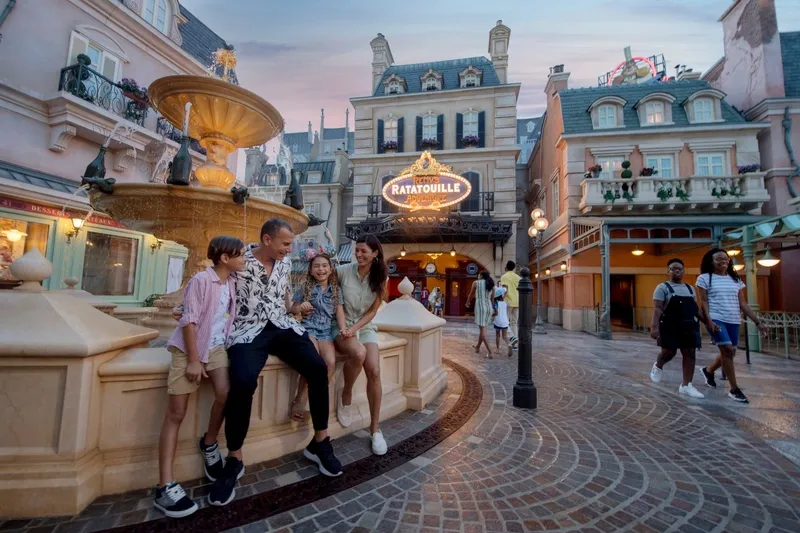
Why do we always want to return to Disney? The details that make us want to come back
There is a phrase that appears very often after a Disney trip.
“We have to go back.”
Sometimes we haven't even left the park and we are already imagining the next time. Other times it happens weeks later, when a photo appears on our phone, we hear a melody that takes us back to a specific moment, or someone starts a conversation with a simple: “Do you remember when…?”
And the funny thing is that we don't always want to return because we have pending attractions.
In fact, it is often difficult to explain exactly what it is that we miss.
We say it's the magic.
And yes, there is something to that. But that feeling we call “Disney magic” doesn't appear by chance. Behind it is architecture, music, lighting, materials, scents, scales, small hidden details, and a very particular way of building places so they don't just seem like sets, but worlds where for a few hours we feel like we are inside another story.
The interesting thing is that we barely need to notice all that work for it to function.
Perhaps that is one of the reasons why we always end up thinking about returning.
We don't remember Disney as a list of attractions
When we are organizing a trip, it is quite normal to think in terms of things to do.
This attraction.
This restaurant.
This show.
This character.
This area we don't want to miss.
But when time passes, memory doesn't usually store the trip like a spreadsheet.
We remember moments.
Perhaps an attraction will become one of our favorites, of course. But we can also perfectly remember how Main Street looked at dusk, the music that played while we walked somewhere, that time we sat down unexpectedly, or the look on someone's face in our group when they saw something for the first time.
That is why we insist so much at Chispa Mágica that a Disney trip does not necessarily improve just because we manage to do more things.
In our guide on what to do in Disneyland Paris during your first visit We are talking precisely about this: priorities serve to protect what we truly want to remember, not to turn a vacation into an endless to-do list.
And Disney is especially good at creating the context for those memories to emerge.
Smells can also be part of a story
There are smells capable of taking us back to a place before we even have time to think about why.
Disney knows this.
Walt Disney Imagineering and Disney Live Entertainment have used scents as a storytelling tool in certain experiences for years. Disney itself has explained that attractions like Pirates of the Caribbean, Spaceship Earth, or Soarin’ Around the World use fragrances that have become strongly associated with those memories. In certain shows and seasons, specific scents such as pine, ginger, or peppermint are also used to enhance the scene the guest is experiencing.
That does not mean there is a machine spraying a secret perfume at every corner of every park.
The reality is much more interesting.
It means that the sense of smell is considered another part of the experience when it makes sense for the story.
And we have a beautiful example right here at Disneyland Paris. During the transformation of the Disneyland Hotel, Disney explained that the lobby was designed with lighting, sounds, and scents that evolve depending on the time of day. It is not just what you see when you walk in: the space changes in a more subtle way.
Perhaps we will never walk in there consciously thinking, “this place smells a certain way.”
But that is not necessary.
Our brain is already building the memory.
There are things placed exactly where they need to be
Another one of the great secrets of a Disney park is that we rarely feel like we are simply walking between buildings.
There are places toward which our gaze is drawn almost effortlessly. Elements that seem larger, further away, or more imposing than they actually are. Changes in materials, colors, and scale that help an area feel distinct from the previous one.
One of the techniques historically used by Imagineering is forced perspective, playing with proportions to modify how we perceive a building or a distance. Disney has documented its use in different parks and structures throughout its history.
But you don't need to study architecture to notice it.
You just need to walk.
Good environmental design ensures our attention goes where it should without us feeling like someone is telling us where to look.
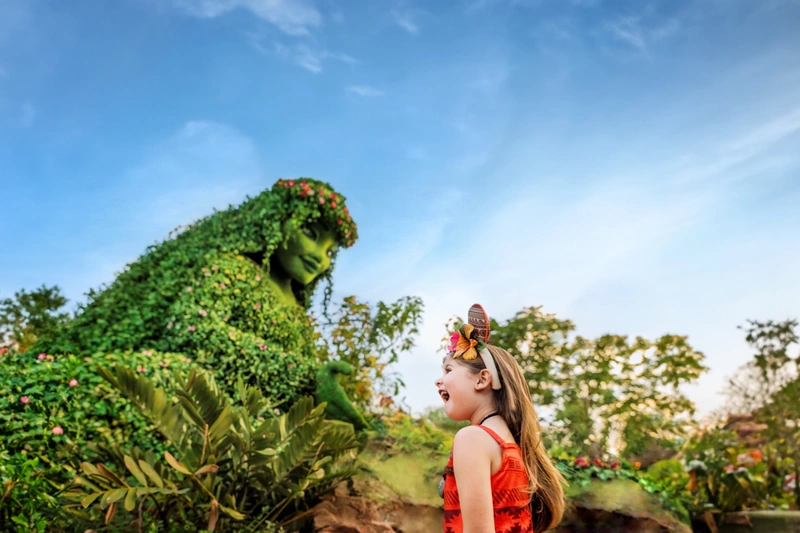
And that gives the parks something very difficult to reproduce in a photograph: the sense of discovery.
You walk a few meters and a different perspective appears.
You turn a corner and the atmosphere changes.
You enter another area and the visual story transforms.
You are not just looking at sets.
You are moving through them.
And some details are there even though we will probably never see them.
This is one of my favorite things about Disney.
There are details whose existence is not necessary to understand the park.
And yet they are there.
At Sleeping Beauty Castle in Disneyland Paris, for example, there are small golden snails climbing up two of its towers. Disney Imagineering has shared that they were born as a nod to French gastronomy: apparently, they are trying to escape the chefs.
Do you need to know this to enjoy the castle?
Not at all.
Is it wonderful to discover it after having walked past it several times?
Yes, it is.
The same applies to the Disneyland Hotel. Imagineering worked alongside artists from Walt Disney Animation Studios to fill the space with small references, from details linked to deleted scenes to nods to historic Disney artists and designers. Some are quite visible; others may go completely unnoticed during a first stay.
And that is where one of the great incentives to return appears.
The first time we look at the big picture.
The next time we start to see the small details.
The music also tells us where we are
There are Disney songs that we identify within two notes.
But a large part of the sound work in the parks is not intended for us to stop and listen to it.
It is intended to accompany us.
Imagineering specifically works on the soundscapes of its experiences: music, atmosphere, and sound are part of how an attraction or space is built. The official series itself We Call It Imagineering dedicates one of its episodes to showing the work that goes into those soundscapes.
And that is probably why something quite curious happens.
During the trip, we might not think: “how well designed the music in this area is”.
But months later we hear that melody and we are back there again.
We know exactly where we were.
With whom.
We can even remember the approximate time of day.
Music becomes a kind of shortcut to memory.
That is why there are people who return home and continue listening to soundtracks from parks, attractions, or shows.
They are not just listening to a song.
They are trying to recapture for a few minutes how they felt there.
The first visit and the second do not show us the same park
The first time we are usually too busy discovering everything.
We try to orient ourselves, understand how the day works, find attractions, check schedules, and verify if we are making the most of the trip.
Our brain has a lot of work to do.
When we return, part of that burden disappears.
We already know where we are.
We recognize places.
We have favorites.
And then something beautiful happens: we start to look up.
We see facades that the first time were just the path to an attraction. We notice details of the hotel. We allow ourselves to stroll through an area just because. We can repeat something without feeling like we are missing the opportunity to discover something else.
That is why returning to Disney for a second time does not necessarily consist of looking for a completely new destination or waiting for enough attractions to have opened.
The same place can feel different because we already know how we want to experience it.
We also want to return because we create our own rituals
Here Imagineering no longer has anything to do.
We provide this part ourselves.
It could be always starting with the same attraction. Or when we buy something small before returning to the hotel.
Taking a photograph in a specific place.
Returning to a restaurant. Sitting for a while on the same bench. Or dedicating the last few minutes of the night to walking without any plan.
The first time, something happens by chance. The second time, we want to repeat it.
And without realizing it, we have created a ritual.
That transforms our relationship with the destination because a place stops being just pretty or fun and starts to hold our memories.
We are no longer just looking at a street.
We are looking at the street where that thing happened.
We are not just entering a restaurant.
We are returning to the place where we had that conversation.
That is when Disney starts to feel strangely familiar.
We return to the same place, but we have already changed.
This is another reason why a second, third, or fourth visit can make perfect sense.
A family does not remain frozen.
Children grow up.
Parents experience the trip in a different way.
Perhaps the first time you went with small children and now you are traveling with teenagers. Maybe that first trip was as a couple and the next one will be with the whole family. Or it could be just the opposite: returning as adults to a place we first knew as children.
The destination may be similar, but the people arriving are not.
And that changes the priorities.
It changes what excites us.
It changes how much we want to rush.
It even changes what we notice.
Sometimes Disney transforms.
Other times, we are the ones who have changed enough to see it differently.
New features help, but they don't explain on their own the desire to return.
Of course, there is something exciting about discovering a new area, a newly opened attraction, or a restaurant that didn't exist during our previous visit.
Disney destinations are constantly evolving.
But if new features were the only reason we returned, we would probably always wait until there were enough new things.
And it doesn't work like that.
Often, we want to return precisely to what we already know.
To our favorite attraction.
To that hotel.
To a specific corner.
To a feeling.
The new sparks curiosity.
The familiar holds memories.
And a good trip might need a little bit of both.
Perhaps that is why nostalgia begins before returning home
There is a quite peculiar moment that happens on many Disney trips.
We are still there and we are already missing it.
It can appear on the last night.
When we pass through an area and we know it will probably be the last time during that trip.
When someone says “next time we could…”.
Or when that strange mix arrives between being exhausted and not wanting it to end.
Nostalgia usually belongs to the past.
Here, it sometimes begins before the trip has ended.
And perhaps it is because during those days we pay a lot of attention to being together.
We wait together.
We choose together.
We get excited together.
We also get tired together, because no magic eliminates the miles walked.
But we share a huge amount of small moments that in daily life probably wouldn't happen in the same way.
The parks can create the perfect setting.
They cannot decide what will happen between the people walking through them.
That remains ours.
So, why do we want to return to Disney?
Probably because Disney works with many more layers than we consciously see.
There are scents used to trigger emotions and memories, music designed to be part of a place, visual techniques that alter our perception, architecture full of narrative, and details so small they can wait years until someone discovers them.
But that is only half of the answer.
The other half is us.
Disney can decide where to place a light.
It cannot know what conversation we will have beneath it.
It can design an attraction for years.
It cannot choose which one will end up becoming our family's favorite.
It can fill a hotel with hidden references.
But it cannot foresee which small moment we will remember ten years from now.
Perhaps that is why the desire to return is so hard to explain.
We don't just want to return to a park.
We want to return to a place we already associate with a specific version of ourselves.
With certain people.
With a certain stage in life.
With a certain feeling.
And when we return, we find something we already knew and, at the same time, discover that it is not exactly the same.
Fortunately.
If that desire to return has already appeared, you can plan your next trip without trying to copy the previous one. And if you are still preparing your first adventure, we can help you discover which way of experiencing Disney fits you best, both in a trip to Disneyland Paris like in a Walt Disney World trip.
At Chispa Mágica, we believe that a Disney trip shouldn't look like everyone else's.
It should end up having details, moments, and memories that only make sense to you.
And perhaps that is, in the end, the best reason to want to return.