
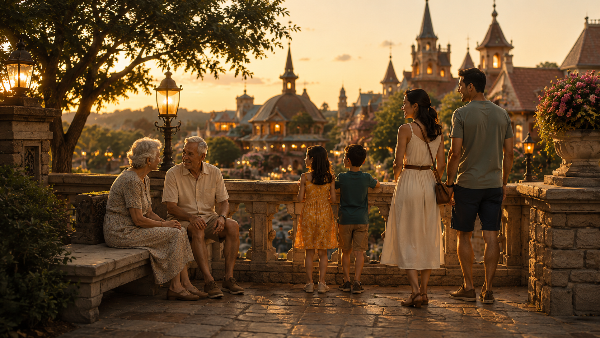
Disneyland Paris and how to organize a trip for three generations
Traveling to Disneyland Paris with grandparents, parents, and children can become one of those memories a family recounts for years. It can also be more demanding than expected when everyone tries to walk, rest, eat, and have fun at the same pace.
The key is not to prepare three different trips or to design an itinerary that everyone has to complete. It's about finding a balance between the moments you want to share and the freedom each person needs to enjoy in their own way.
A tailor-made family trip to Disney starts precisely there: understanding who is traveling, what excites each person, and what decisions can make everyone feel part of the experience.
Because sharing the trip doesn't mean having to do absolutely everything together.
Before preparing the day, understand who is traveling
When we think of three generations, it's easy to assign them a role: children have energy, parents organize, and grandparents need to rest. Reality is rarely so neat.
There might be a grandparent eager to start early while one of the children feels tired after lunch. A grandmother might particularly enjoy the rides, and a teenager might prefer to wander, take photos, or stop at shops. Age guides, but doesn't solely explain how a person enjoys themselves.
Therefore, before deciding what you are going to do, it is worth talking about how you like to travel. How much time each person feels comfortable walking, which moments of the day are usually more difficult, who needs to take frequent breaks, and what experience would make each person feel that the trip is also designed for them.
Our guide on Disneyland Paris with young children Develop how children's fatigue and breaks influence the trip. When multiple generations travel, this perspective needs to be broadened: adults can also get overwhelmed, need quiet, or prefer a less intense day.
Talking about these things before leaving doesn't diminish the excitement. It prevents needs from arising for the first time when the group has been walking for hours and no one wants to be the one to suggest stopping.
Choose a small core of shared moments
Many families prepare for the trip with an itinerary that everyone must complete. On paper, it conveys unity. In practice, any change can feel like a problem.

It works better to choose a few common moments in advance. It could be a meal, an experience that particularly excites the children, a specific walk, or a part of the day that the whole family wants to remember together. That small core gives meaning to the trip without turning every hour into a collective obligation.
Around these moments, there can be more freedom. One part of the group can seek more intense experiences while another rests or enjoys the atmosphere in a calm way. Later they reunite without the feeling that someone has waited for hours or constantly had to give something up.
This flexibility also allows for the discovery of something important: not all family memories are born from a big, scheduled experience. Sometimes they appear while grandparents watch their grandchildren's excitement, during an unhurried conversation, or in a break that no one had considered important before the trip.
Sharing doesn't mean staying together non-stop. It means that shared moments have value for everyone.
Mobility deserves its own conversation
Energy and mobility are related, but they are not the same. A person may get tired sooner and walk normally. Another may need to sit down frequently. There may also be someone who uses a wheelchair, requires assistance with certain movements, or has a recognized disability.
Mixing all these situations leads to wrong expectations.
When there is a specific need for accessibility, it is advisable to consult the official information from Disneyland Paris before planning your day. The destination publishes guides on accessibility, conditions for accessing experiences, evacuation, and available services. Some procedures vary depending on the attraction and the person's degree of autonomy, so it is not recommended to assume that all work in the same way.
Disneyland Paris also provides a wheelchair rental service. Availability and conditions should be checked prior to travel.
Using a mobility aid should not be presented as a last resort or as something that changes the meaning of the vacation. For some families, it may be precisely what allows them to conserve energy and share more moments peacefully.
You can check the updated information in the official Disneyland Paris accessibility guide.
The Priority Card is not age-dependent
One of the mistakes to avoid is automatically associating advanced age with priority access.
The Disneyland Paris Priority Card is intended for visitors who can officially prove a disability through one of the accepted documents. The access it offers is priority, but not immediate, and its operation also depends on the safety and evacuation conditions of each experience.
This means a person may need to walk less or take more breaks without qualifying for that card. In that case, comfort should be addressed in the trip's design: reducing unnecessary travel, allowing room for rest, and avoiding a rigid sequence for each day's activities.
When a recognized disability does exist, documentation and conditions should be reviewed in advance. It's not advisable to wait until arrival to discover which resources are applicable to the traveler's specific situation. The official information regarding the Priority Card allows you to check current requirements.
Accommodation must work for the entire family
On a getaway spanning three generations, lodging influences more than just nighttime rest. It can make it easy for one part of the family to slow down while another keeps going, or turn a brief pause into a trek nobody wants to make.
That doesn't mean the closest option is always the best. Budget, transportation, room layout, and travel style remain important factors. The key is to view accommodation as one piece of the journey, not just a place to sleep.
It's also worth considering how you'll distribute the rooms. Do you want to be all close together? Do you need separate spaces for resting? Are there people who wake up much earlier than others? Does any traveler need an accessible room or a specific setup? What will happen if part of the group wants to return to the accommodation before the others?
These questions may seem secondary until the first night arrives. A layout that offers privacy and facilitates rest can make the trip much more comfortable, especially when different schedules coexist.
Disney Hotels have accessible rooms subject to availability. If there is a specific need, it must be communicated and confirmed during booking, always using the current official information.
It's not about automatically choosing the most expensive or closest hotel. It's about finding accommodation that allows your family to rest, get around, and organize themselves with the autonomy they need.
Meals can bring the group together without dictating the entire day
A shared meal can be one of the best moments of a multigenerational trip. It's an opportunity to pause, discuss experiences, and reunite after enjoying different activities.
But it can also become a source of tension if you try to make everyone hungry at the same time or if the itinerary forces too many breaks.
Before booking restaurants, think about how you normally eat when you travel. Some families enjoy sitting down calmly for lunch and dinner. Others prefer a well-organized main meal and keep the rest of the day more flexible. There might be children who need to eat earlier or adults who would appreciate a longer break.
Not all meals need to be special. Sometimes it's enough to choose a dining experience that everyone is excited about and let the others fit the pace of the trip.
If you are considering a meal plan, our guide on half board or full board at Disneyland Paris helps you decide based on how your family actually eats, not solely on the number of meals included.
Dining should bring convenience. It shouldn't force you to reorganize the park just to justify what you've booked.
Parents are also part of the journey
In multigenerational families, invisible labor often appears. Parents keep track of documentation, manage timing, answer questions, check on the children, and observe if grandparents need to stop. While everyone else experiences the trip, they coordinate it.
The organization can be shared with small agreements. One person can be in charge of checking certain practical information; another can accompany the children at a specific moment; adults can decide in advance how they will act when someone prefers to return or follow a different plan.
It's not about assigning tasks as if the trip were a work project. It's enough to avoid having all decisions always fall on the same person.
It also helps to agree that no one will have to defend their need to stop. A phrase as simple asI'll stay here for a while and we'll meet latershould be said without guilt and without opening a family negotiation.
When the group accepts this freedom before the trip, parents stop acting as permanent referees. They can be present in the experience instead of just making sure everything works.
A tailored family budget also requires setting priorities
When multiple generations travel, budget can become a delicate conversation. Not everyone necessarily has the same financial availability or places the same importance on each part of the trip.
That's why it's a good idea to discuss before booking what expenses will be shared, which ones each person will cover, and which experiences you want to prioritize as a family. It doesn't need to be a complicated negotiation, but it's important to avoid different expectations that might arise once reservations are confirmed.
Perhaps for some, accommodation is especially important because it facilitates rest. For others, a shared meal or having more time is what matters. Personalized planning helps compare those priorities and find a balance, without assuming that the whole group must spend exactly the same way at all times.
The goal is not to build the most expensive trip or the one most full of extras. It is to ensure your budget serves what truly matters to your family.
Separating for a while can enhance moments together
Some families easily accept splitting up. Others find it difficult because they feel that by doing so, they are losing part of the shared experience.

In reality, a brief separation can avoid long waits and silent sacrifices. While some enjoy an experience that appeals to them, others can rest or choose a plan more suited to that moment of the day. The reunion comes with more energy and something new to share.
For it to work, a complicated schedule is not necessary. It is best to agree on a simple meeting point, an approximate time frame, and what will happen if someone is running late. It is also important that no single member of the group is always assigned to resting or taking care of others.
Preferences should not be automatically divided by generations. Asking who wants to do what usually yields more surprising and useful answers than assuming them.
This way of organizing the day allows the family to stay together without having to act as a single block.
Let the plan age well during the trip
An itinerary can seem perfect the week before and need changes as soon as the family experiences the first day. Perhaps distances feel longer than expected. Maybe the kids prefer to repeat a specific moment or the grandparents find they are comfortable for longer periods of time.
The plan should be able to absorb those surprises.
When the stay is too compressed, any pause creates the feeling of missing out. The Chispa Mágica article on Disneyland Paris in three days and two nights explains how duration relates to pace, fatigue, and expectations. In this multi-generational content, one idea is enough to keep in mind: the more different paces coexist, the more important it is to leave room to adjust the day.
Changing the order, resting earlier, or skipping an experience does not make the day a failure. Good planning is not the one that is followed without deviations, but the one that allows you to make decisions without everything else falling apart.
Is it a good idea to split the group up at Disneyland Paris?
It can be a good decision when there are different interests or energy levels. It works best when the family has chosen common moments, has a clear meeting point, and no one is always relegated to the role of companion.
Does an elderly person have priority access?
Age alone does not grant a Priority Card. Disneyland Paris requires officially recognized disabilities and valid documentation. Furthermore, access is prioritized, but not immediate. Current conditions must be checked prior to travel.
Is it necessary to choose a nearby hotel?
Not necessarily. Proximity can facilitate rest and temporary separation, but the decision also depends on budget, transportation, group autonomy, and accommodation layout. The key is to evaluate the actual comfort for a full day.
A trip designed for everyone does not have a single pace
Perhaps one of the children wants to keep going a bit longer. Maybe the grandparents prefer to stop and watch the atmosphere. Perhaps the parents will discover that their favorite moment was precisely when they stopped trying to make everything fit.
That is also traveling together.
Disneyland Paris can bring three generations together around a shared dream, but the memory won't be better just for having completed a longer schedule. It will be valuable because each person found their place within the trip and because the family knew how to recognize which moments were truly worth sharing.
The Disneyland Paris trip page can serve as the next step to explore the destination, its options, and the type of planning that best fits the family. The first gesture, however, can be made long before booking: sitting down together and asking what each person needs in order to enjoy it.