

Half board or full board at Disneyland Paris: which fits your trip better
There are some decisions about Disneyland Paris that seem pretty easy until the time comes to book them. The meal plan is one of them.
You see half board. Then you see full board. And the initial reaction might be to think that if one option includes more meals, it will surely also be the one that offers the best value. More things paid for before the trip, more control over the budget, and fewer decisions once you are there. It sounds convenient, and it can be.
But before choosing, there is a question that helps much more than simply comparing how much each package includes:
How will you actually want to eat when you are at Disneyland Paris?
Because a meal takes up more than just the time you spend sitting at the table. It also introduces a pause, influences to some extent where you want to be at a certain time, and can change the pace of attractions, shows, and strolls.
That is why, when planning a trip to Disneyland Paris, I wouldn't look at the dining plan as an isolated decision. It has to fit with the rest of the trip.
And therein lies the real difference between booking something that gives you peace of mind and booking something that later feels like an obligation to get your money's worth.
Having more meals included doesn't necessarily mean traveling better
Having part of your dining arranged before you arrive has clear value. It helps forecast expenses and reduces the number of decisions you'll have to make during your vacation. For many people, that brings immense peace of mind, but that convenience disappears when the plan starts dictating your day too much.
Imagine you've booked a full board plan and, once there, you discover that on some days you don't feel like having two main meals. Perhaps breakfast was hearty, you're enjoying a particular area of the park and prefer to keep going, or you simply aren't hungry enough to sit down for a meal again.
At that moment it's very easy to think: "But we have to make the most of it".
And that phrase says a lot.
A plan we had booked to feel more relaxed can end up becoming another obligation.
The right choice isn't the one that lets you say you have more things included. It's the one that makes sure, when mealtime arrives, the plan fits naturally with what you already wanted to do.
What is the real difference between half board and full board
Disneyland Paris currently offers meal plans associated with stays at Disney Hotels. Generally speaking, the half board combines breakfast with one main meal per person and per night of stay, while the full board extends that structure to two main meals. Disneyland Paris also establishes that the plan must be booked for all members of the party and for the entire duration of the stay.
That functionality serves to understand the essential difference, but it shouldn't be what ultimately decides your choice just yet.

What matters is what it entails during the actual day.
With half board, there is one main meal that you can easily integrate into your day, leaving more freedom around it.
With full board, a much larger part of your dining is structured from the start.
Neither formula is better in the abstract. The question is how much that structure helps you.
When half board can fit particularly well
Half board makes a lot of sense when you like arriving with a significant part of the day organized, but want to keep some leeway to decide on the fly.
You can know there will be a lunch or dinner where you will truly stop and let the other part of the day be more flexible.
For some travelers, that balance works wonderfully.
Perhaps you like to have a good breakfast, a main meal, and then handle the evening more lightly. Or maybe you prefer to keep going during the day and reserve that calm moment for dinner.
It also works well when you don't want dining to be the main focus of every day. You can have a special experience, enjoy restaurants you're looking forward to, and at the same time, not feel like every day has two major breaks to fit in.
That freedom can be very valuable at Disneyland Paris because days don't always end up looking like what we had imagined from home.
An attraction is more fun than expected. A show changes the pace. Fatigue sets in. Or you're simply enjoying a moment and don't feel like interrupting it yet.
Having some leeway helps the plan adapt to you.
When full board can give you more peace of mind
There are travelers who prefer just the opposite.
Improvising where to eat causes them more mental noise than freedom. They like knowing that a significant portion of dining is already taken care of and they enjoy sitting down calmly for both lunch and dinner.
For them, the full board meal plan might be a much better fit.
Especially when dining is part of the experience rather than seen as "time taken away from the park".
A long break might be precisely what helps you enjoy the second half of the day more. It's a time to rest, talk about what you've done, and head back out with renewed energy.
At Chispa Mágica we have talked about that feeling in specific experiences like Walt’s – An American Restaurant, where sitting down for a more leisurely meal is part of the restaurant experience itself.
If that way of traveling suits you, a more structured dining plan can be very convenient.
But the key is that you genuinely want to take those breaks, not just that the plan includes more.
Before choosing, imagine a typical day for you
Sometimes we make the decision complicated because we start by looking at names, categories, and conditions.
I would try the exact opposite.
Forget about "half board" and "full board" for a few minutes and picture your day. You've had breakfast and are entering the parks. You spend the morning between attractions, walks, and shows. It's time for lunch.
What would you normally do? Would you like to sit down leisurely? Do you prefer to grab something lighter and keep going? Do you usually have two large meals when traveling, or does one of them end up being much simpler?
Now think about the evening.
Do you like to end the day sitting around a table? Or are there days when, after having eaten well, you simply prefer something light and resting?
These answers are usually much more useful than trying to calculate which of the two plans has "more value".
Because two families staying at the same hotel can make opposite decisions and both be completely right. The difference lies in how they travel.
Having a dining plan does not mean having a reserved table
This is one of the details that is good to know before booking.
The meal plan and the restaurant reservation are two different things.
Disneyland Paris expressly states that purchasing a plan does not guarantee a table at a restaurant. If there is a specific place where you are especially excited to eat, it is advisable to manage that reservation according to the current conditions.
This avoids a rather common confusion.
Having full board does not mean that all meals of the trip are automatically organized by location, time, and restaurant. What you have organized is the meal plan.
Then you have to make the dining experiences that really matter to you fit into your itinerary. And precisely for that reason, choosing the right plan does not eliminate planning. It simplifies it.
The problem begins when we try to "get our money's worth" out of every meal.
When something is paid for in advance, it is completely normal to want to use it.
However, there is an important difference between making the most of a plan and organizing your day around not missing any part of it.
If mealtime arrives and you are not hungry, but you feel you must go anyway because it is already included, the chosen package might not match your actual way of traveling as closely as you thought.
Disneyland Paris establishes specific conditions for the use of vouchers and their value, so it is always worth reviewing the option associated with your reservation before finalizing your trip.
But from a planning perspective, the conclusion is simpler: do not book more structure than you actually want to use.
Because the goal should not be to finish your vacation thinking that you squeezed out every single voucher.
It should be to feel that you ate well, that your budget was under control, and that breaks happened when they made sense.
A special meal does not have to dictate the entire plan
There may be one or two restaurants that are part of the magic of the trip for you.
That changes the priorities and is worth keeping in mind.
For example, an experience like Agrabah Café can be much more than just grabbing a meal if you feel like enjoying the atmosphere and taking a different kind of break inside the park. However, I would try not to let a single experience dictate the entire dining structure for a multi-day stay.
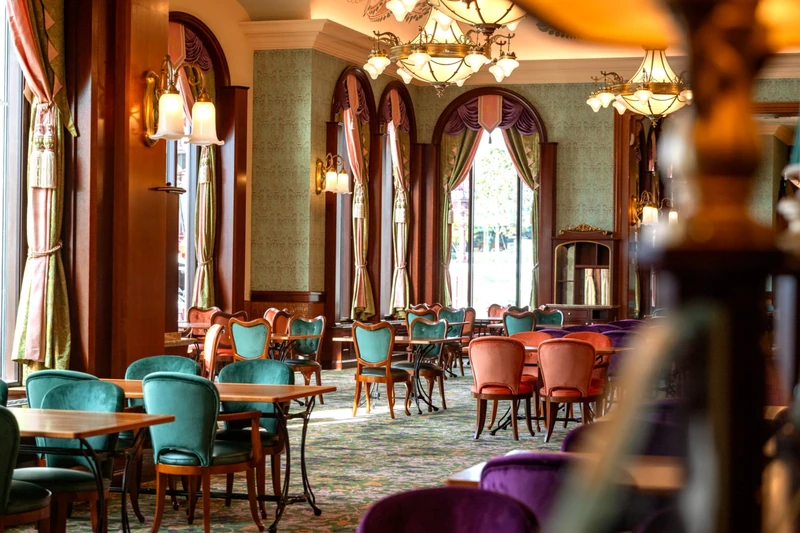
First, I would think about how you want to eat for the majority of the trip. Then, I would fit in those special meals.
It is much easier to introduce one or two important dining moments into an already working plan than to build every day around a single reservation.
So, half board or full board at Disneyland Paris?
If you want simple guidance, I would start here.
Half board usually fits best when you want to have one main meal organized each day and keep more freedom for the rest. Full board deserves more consideration when you like to take two main breaks to eat and appreciate having a larger portion of the budget and structured dining planned in advance.
However, I wouldn't use that phrase as a rule.
There are couples who will prefer full board and families who will enjoy half board much more. There are people who need to stop to regain energy and others who feel that too many meals break their rhythm.
The important thing is to identify which group you are.
Because the useful question is not "which plan is a better value?".
It is:
"Which plan is a better value for the trip we want to take?"
That is usually when the answer becomes much clearer.
The best meal plan is the one that stops feeling like a plan.
This is the best sign that you have chosen well:
It is time to eat and you feel like stopping, you have a reservation, and it fits the time of day. Your budget is under better control, but you do not feel like you are chasing pre-booked meals.
There is no need to constantly think about whether you are making the most of the plan or not. It is simply part of the trip. That is what it should achieve.
That is why, before deciding between half board and full board at Disneyland Paris, think less about which one includes more and a little more about your actual way of traveling.
How you eat when you are away, how much you like to improvise, how important it is to sit down calmly, and what role you want to give to restaurants.
And how much of the budget you prefer to have organized in advance.
When those answers are clear, half board and full board stop looking like two packages that are difficult to compare.
One starts to look much more like your trip than the other.
If you are hesitating between both options, at Chispa Mágica we can help you evaluate which plan fits best with your hotel, your pace, and the way you want to organize your meals.
Discover our custom Disney tripsand let's design a trip where meals complement your days rather than dictate them.