
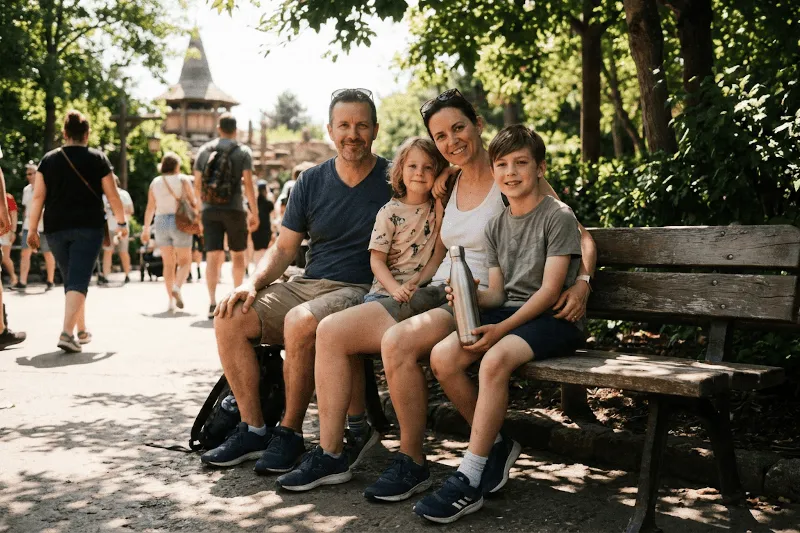
Disney in the heat: how to plan your summer trip without getting exhausted
Traveling to Disney in the summer can be wonderful.
The days feel long, you want to make the most of every moment, and there's something especially beautiful about seeing how the atmosphere changes as evening approaches. But summer also introduces a variable that can completely alter a plan that seemed perfect on paper: the heat.
Not because it makes it impossible to enjoy the trip, far from it.
The problem arises when we plan a summer day exactly like we would plan any other time of year. Many hours of walking, too many priorities in a row, few breaks, and the feeling that, since the park is open for many hours, we also have to be at our best for all of them.
That's when a beautiful day can end in exhaustion.
The key to traveling to Disney in the heat isn't trying to endure longer. It's about distributing energy better.
And that nuance changes the experience quite a bit.
Experiencing Disney in the summer isn't the same across all destinations.
Before we talk strategies, there's something important: you shouldn't lump Disneyland Paris and Walt Disney World into the same category.
Disneyland Paris specifically promotes spring and summer as times with longer days, extended hours, and numerous outdoor experiences. The official website itself suggests alternating these moments with indoor dining, cold drinks, and items like water bottles, caps, hats, or sunglasses.
That doesn't mean every summer day is the same or that we know in advance what the temperature will be during your trip.
It means that the heat and outdoor weather deserve to be part of the planning.

Something similar happens at Walt Disney World, but in a different context. Disney expressly recommends preparing for the Central Florida climate and checking the weather forecast before and during your stay. It also reminds you that intense weather conditions may modify, delay, or cancel certain experiences.
That's why, when we say 'Disney in summer,' the real strategy should start with a very simple question:
Which Disney are we going to and how do we want to experience our days there?
We don't need a universal formula.
We need flexibility.
The mistake isn't traveling in summer. It's planning as if energy were infinite.
Long days can be deceiving.
We see many available hours and automatically think about everything we could fit in: attractions, restaurants, shows, characters, photos, and maybe a repeat if the day goes well.
The problem is that more park hours don't necessarily equate to more energy.
And the more packed the plan, the less capacity we'll have to adapt it when someone is tired, needs to stop, or simply wants to sit down for a while.
At Chispa Mágica, we prefer to design summer days with moments of intensity and moments of recovery.
This might mean starting the day with some clear priorities while the group is fresh, then leaving a quieter part for lunch, rest, or enjoying indoor spaces, and regaining flexibility for the afternoon and evening.
There's no need to schedule a break at 1:47 PM or decide exactly where you'll sit from home.
The important thing is that such a break can exist.
Because if your plan requires everyone to be at one hundred percent for ten or twelve hours to work, it's probably not a good summer plan.
The morning can have priorities; the rest of the day needs to breathe
Something works especially well when it's hot: not distributing important priorities randomly.
If you have two or three experiences that you would really regret missing, it can make sense to give them prominence in the early part of the day instead of leaving all the important decisions until you've already been walking for several hours.
After that, the pace can become much more flexible.
A sit-down meal can become more than just "mealtime." It can be a real break. An indoor attraction can fit precisely when the group needs to slow down. A walk can be postponed if no one feels like walking more at that moment.
That doesn't mean doing less.
It means stopping to consider any break as wasted time.
In fact, many days that seem "less productive" on paper end up feeling much better because the group conserves energy for the end.
And that difference matters especially on multi-day trips.
We are not only organizing for today.
We also want to arrive well tomorrow.
Walking less is also a strategy against fatigue
You walk in Disney parks.
A lot.
That's part of the experience and it doesn't make much sense to try to eliminate it. But we can avoid a part of the travel that contributes nothing.
One of the decisions that helps the most in summer is to think about the route with a certain geographical logic.
If you are going to spend time in an area, it may be more comfortable to take advantage of several nearby experiences before crossing to the other end because you suddenly saw a wait that seems attractive.
It's not about touring the park as if you were solving an equation.
It's about avoiding those days when we end up going back and forth continuously because each decision was made in isolation.
In summer, these unnecessary movements are more noticeable.
If you want to delve deeper into this way of organizing the route, we have a specific guide on how to design a personalized itinerary for Disneyland Paris, where we explain how to combine priorities, zones, and buffer time without turning the day into a rigid schedule.
Eating can become part of the strategy
On some trips, sitting down to eat seems like a waste of time.
In hot weather, the opposite can happen.
A well-timed meal can help divide the day into two much more manageable parts. Not only because you stop walking for a while, but because the group has a natural moment to pause, assess how everyone is feeling, and decide what makes sense to do next.
At Disneyland Paris, the official summer communications themselves suggest both outdoor seating areas and indoor restaurants, which can serve as a cooler refuge during the day.
This doesn't mean you have to book a big meal every day.
You might want to have one special meal and leave the rest much more flexible.
The important thing is to understand that meals also influence the pace.
If the group is tired, perhaps that hour sitting down contributes much more to the trip than trying to fit in another experience before stopping.
And if you regain energy afterward to enjoy the afternoon, that break hasn't taken away time.
It has given it back to you in another way.
What to bring when it's hot
There's no need to turn your backpack into an expedition.
The useful thing is to bring what allows you to be comfortable and avoid minor complications during the day.
Disneyland Paris includes items like water bottles, caps, hats, and sunglasses, as well as cold drinks, among its summer recommendations and products.
We would add a simple idea: think about what you already know you need to spend many hours walking outdoors.
Clothes you are comfortable in, shoes you haven't worn for the first time that day, sun protection according to your needs, and a backpack light enough not to end up hating it by mid-afternoon.
The fewer useless things you carry, the better.
And if you're traveling with children, the criteria should be the same: bring what you actually use with them, don't try to anticipate twenty problems that probably won't happen.
Disney in the summer with children: less obsession with "making the most of it"
With children, initial enthusiasm can be misleading.
They arrive at the park, they want to see everything, and it seems like they could keep going for hours.
Until they can't anymore.
That's why I would try not to use all that initial energy as an excuse to fill the morning until the last minute.
A family can have a perfectly organized plan and discover there that the children's real pace is different.
And changing it doesn't mean we've planned the trip badly.
It means we're reacting well.
They might need to sit down sooner. A meal might take longer. A quiet attraction might be just what they want instead of moving on to the next priority.
The important thing is not to wait until exhaustion is evident to start planning a break.
I would also avoid bringing entertainment, snacks, or "line survival" resources as if every family needed the exact same things.
Every child is different.
The best strategy is usually understanding their pace and avoiding a schedule that relies on them behaving differently than they normally do.
Disney in the summer as a couple or adults only also requires pacing.
Traveling without children offers more flexibility, but it does not make anyone immune to fatigue.
Sometimes, precisely because you don't have to worry about naps, children's schedules, or specific needs, you end up planning even longer days.
And that isn't always worth it.
As a couple or among adults, summer can be a wonderful opportunity to enjoy the experience differently: a long meal, a late afternoon stroll, returning to an area you particularly enjoyed, or spending time with no scheduled activities at all.
There is no need to prove that you can stay from opening to closing.
The trip does not automatically improve by accumulating hours inside the park.
It improves when those hours remain enjoyable.
If you are thinking about this kind of getaway to Disneyland Paris, you can see how we plan our tailored Disneyland Paris trips.
Do you need to return to the hotel during the day?
Not always.
And it shouldn't be ruled out either.
If your accommodation is well connected, you have been traveling for several days, and you know a longer break helps you, returning to the hotel can make sense.
But I wouldn't make it a universal rule.
For some families, leaving the park, traveling, resting, and returning works wonderfully.
For others, the commute breaks up the day too much and they prefer to find a break within the park itself. The decision depends on your hotel, your group, and the actual energy of that day.
That is why we like to talk about break, not necessarily "returning to the hotel".
The break is the goal. Where it happens is secondary.
Summer schedules can help… or become a trap
At Disneyland Paris, the official website notes that summer months usually offer extended park hours and more shows and events, although they also tend to attract more visitors.
That opens up possibilities. But it also makes it very easy to think: "if there are so many hours, we have to use every single one of them."
No.
You can enjoy an intense morning, take a substantial break, and find your rhythm again later.
You can also decide to finish earlier if the group has already had enough. The park schedule marks how long you could stay.
Not how long you must stay.
That difference seems obvious, but on Disney trips we forget it quite easily.
At Walt Disney World, besides the heat, always keep an eye on the weather
In Orlando there is another reason not to have a completely rigid itinerary.
Walt Disney World recommends checking Central Florida weather conditions and following their official updates, especially during severe weather situations, as some experiences may be subject to change.
There is no need to spend months obsessing over the forecast.

It is enough to factor the weather into the trip as the date approaches and check it again during your stay.
A good itinerary should be able to withstand changes.
If it requires every single day to have the exact weather we imagined in order to work, it is simply too fragile.
On our page about Walt Disney World we emphasize precisely that properly balancing parks, breaks, and priorities has a massive impact on the final experience.
In the summer, even more so.
So, is it worth traveling to Disney in the summer?
Yes, it can be totally worth it.
Not because summer is objectively better than other times of the year.
It is worth it when it fits your schedule, your destination, and the way you want to travel.
Disneyland Paris can offer long days, extended hours, and plenty of outdoor life during this season. Walt Disney World also maintains a specific summer offering, although Disney recommends paying attention to the Central Florida weather.
The question, therefore, shouldn't just be "is it too hot?".
The useful question is:
Can we organize the trip in a way that the heat doesn't dictate the entire day?
If you leave only a few truly important priorities, reduce unnecessary travel, incorporate breaks, and accept that not every hour needs to be packed, the answer can very well be yes.
Summer doesn't have to turn into an endurance test.
It can simply be another way to experience Disney.
And many times, when we stop trying to squeeze every single minute, those are precisely the moments we remember the most afterwards.
If you are considering traveling in the summer and do not know how to fit dates, destination, accommodation, parks, and breaks so that the trip has a realistic pace, at Chispa Mágica we can design it around your way of traveling.
Tell us about your trip and we will prepare a tailor-made proposal.