
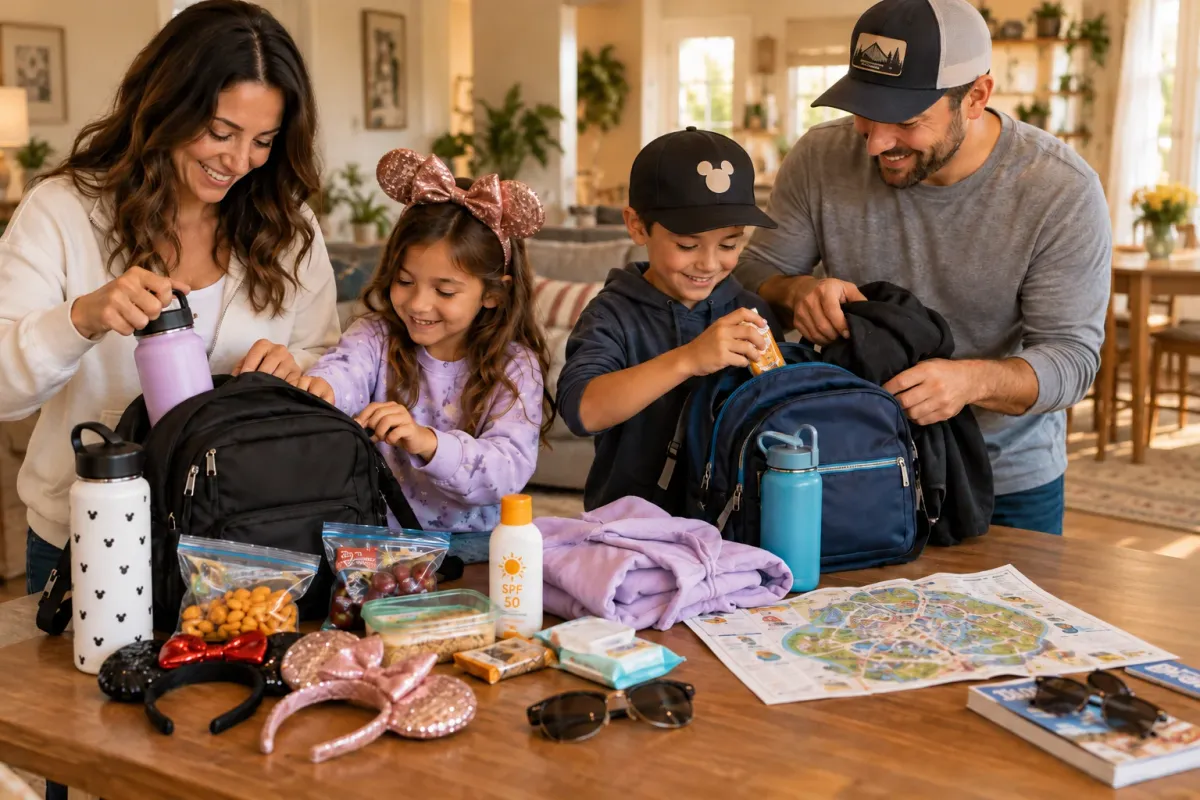
What to pack in your backpack for Disneyland Paris: what you really need and what is extra
There are two pretty quick ways to find out you packed the wrong backpack for Disneyland Paris: at ten in the morning, when you are already wishing someone would take it off your hands, or late in the afternoon, when you are missing the exact thing you decided to leave back at the hotel.
And neither of those has to do with carrying a ton of things.
A good park backpack should not feel like an emergency suitcase meant to last three days. It should contain just enough to solve minor setbacks, keep you comfortable, and save you from having to return to the hotel for something basic. The rest, no matter how essential it seems when preparing for the trip, will likely end up touring Disneyland Paris on your back without you ever using it.
If what you are preparing is your complete luggage, we have a specific guide on what to bring to Disney and how to pack. Here we are going to focus on something else: the backpack that goes into the park with you and accompanies you all day long.
The backpack starts with a decision: how much you want to carry
It is easy to pack a backpack thinking solely about everything that could happen.
What if it rains? What if it is cold? What if someone gets stained? What if we need this? What if we end up using that?
The problem with “just in case” items is that each one weighs little individually, but together they can turn a reasonable backpack into a small move.
Before putting anything in, think about who is going to carry it. It seems obvious, but many times we pack a single backpack for the whole family and end up taking it for granted that the same person will carry it for hours. If it already feels heavy when leaving the hotel, after several kilometers of walking it is not going to feel any lighter.
At Chispa, we like to think about the backpack using a very simple rule: every item should justify the space it takes up.
What you plan to use multiple times during the day is very likely worth it. What you pack just in case a very unlikely situation happens should be thought through a bit more.
And it is completely fine to leave things at the hotel.
You are not preparing for an expedition. You are preparing for a day at Disneyland Paris.
What actually deserves to take up space during the day
There are some basics that, in our experience, usually make a lot of sense because they solve situations that come up over and over again.
One of them is a power bank. Your phone works hard during a visit: we check the official app, take photos, look up park information, and talk to the rest of the group if we split up. Reaching mid-afternoon and anxiously watching your battery percentage is a lot less magical than it sounds.
It also makes sense to bring water in a suitable container. That said, Disneyland Paris expressly prohibits bringing in glass bottles, so you should avoid this material.
From there, the contents should be adapted to your travel dates and travel style. If the forecast points to rain, light protection might make more sense than a bulky garment that takes up half your backpack. If it is cold, what you need will be different. And if you go in the middle of summer, the way you organize your day won't be the same either.
The important thing is not to try to pack your backpack for four seasons at once.
Check the forecast shortly before your trip and adjust then. A backpack packed according to the weather you are actually going to have usually works much better than one designed weeks in advance around every possible scenario.
Small essentials beat big 'just in case' items
A useful backpack is usually made up of small items.
Something for a blister, whatever you personally need during the day, sunglasses if applicable, tissues, your battery, and the small items you know you actually use.
The criteria should be personal.
If you never use something in your day-to-day life and you are only packing it because you saw it on a list of "25 essentials for Disney", it probably deserves a second thought.
This is precisely one of the traps of many packing lists: they end up recommending things that might be useful for someone, but not necessarily for you.
At Chispa Mágica we prefer to look at it the other way around.
Think about what your day will be like.
Think about what usually makes you uncomfortable when you spend many hours away from home.
And solve that.
A couple returning to the hotel in the afternoon doesn't need to pack the same backpack as a family that knows they will be in the park from opening until night. Nor does someone who naturally travels light need the same things as someone carrying glasses, personal medication, or other essentials they actually use.
The ideal backpack is not universal.
If you are traveling with children, the contents change, but it doesn't have to turn into a suitcase.
With kids, it's very easy to fall into the trap of "better safe than sorry".
And sometimes it makes sense to bring a few extra essentials, especially if they are little. But that doesn't mean you have to haul half a nursery around Disneyland Paris.
Depending on their age, a light change of clothes or certain products you use regularly can save you a small drama. The key is to ask yourselves what you need during those hours, not what you normally have available at home.
It is also advisable to distribute things well.
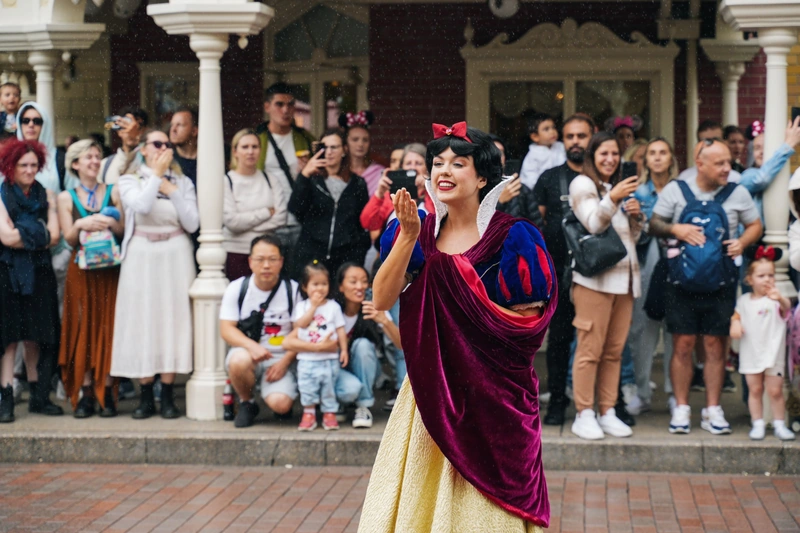
If you are bringing a stroller, it might seem tempting to use it as storage, but Disneyland Paris reminds guests that valuables should not be left unattended and that strollers must be parked outside attractions and show venues.
Because of this, anything truly important should remain under your direct control.
And there is another detail we usually recommend: if you are traveling with multiple adults, everything does not have to fall on a single backpack. Sometimes splitting the weight a little bit is much more comfortable than designing "the ultimate family backpack".
Things we usually pack "just in case" that end up being a hassle
There is no universal list here because every traveler is different, but there is a fairly common pattern: we pack too many clothes, duplicate items, and prepare solutions for situations that will probably never even happen.
Two sweatshirts "in case one gets stained", several chargers when a power bank would better solve the problem, a huge toiletry bag when we will only use two things, or a quantity of accessories that seems small until the backpack has been on our shoulders for hours.
A good test is to finish packing it and then open it again.
Take out everything you think: "I probably won't use it, but...".
You don't necessarily have to remove it. Simply ask yourself what the real problem would be if you didn't bring it.
If the answer is "no significant problem", you might already know what to do.
I would also leave some space inside the backpack. Not for purchases, but for comfort. A backpack completely full from minute one is harder to organize, find things inside, and close quickly when it's time to move.
And during a Disney day you will open it quite a few times.
What could cause problems at security control
This part is worth preparing before leaving the hotel.
Disneyland Paris conducts security checks and reserves the right to inspect visitors' personal belongings both at the entrances and within the parks.
Among the items prohibited by the regulations are alcoholic beverages, glass bottles, dangerous substances or objects, weapons, and toys or objects that resemble weapons. Certain items that may disturb other visitors, drones, and other remote-controlled devices are also prohibited.
There is a rule that may go more unnoticed if you like to record content: Disneyland Paris also does not allow telescopic poles, tripods, monopods, and extendable devices for mobile phones or cameras that exceed 20 cm when unfolded.
And here it is worth making a distinction.
Forgetting your sunglasses at the hotel is not the same as discovering at security that you're carrying a prohibited item. Disneyland Paris states that anyone arriving with one of these items will have to dispose of it before entering.
This is why this part of your backpack is worth a quick check before your trip.
Is there a maximum size for backpacks at Disneyland Paris?
Yes, there is a limitation for bulky items and luggage.
The official regulations do not allow entry into the parks with suitcases, bags, or other items exceeding 55 × 40 × 25 cm, including pockets, wheels, and handles. For this type of luggage, Disneyland Paris recommends using the lockers located outside the parks.
Beyond the rule, our recommendation would be much simpler: even if your backpack is within the permitted dimensions, it doesn't mean you need to use every last centimeter.
A huge backpack can comply with the rules and still be tremendously uncomfortable.
The goal isn't to find out which is the largest backpack you can bring in.
It's to carry the most comfortable one that will see you through your day.
When a locker might be a better idea
There are situations where trying to bring everything in isn't worth it.
Perhaps you're arriving directly from another accommodation, you have luggage you don't want to carry around, or you simply have something too bulky to bring with you throughout your visit.
Disneyland Paris has external lockers for these types of situations, and the park's own regulations recommend using them when carrying luggage that exceeds the admitted dimensions.
I wouldn't make lockers a part of your usual planning if you don't need them. But it's worth knowing the alternative exists before you find yourself with a suitcase at the park entrance.
The best backpack is one that stops being the main focus
There's something curious about a well-prepared backpack: there comes a point in the day when you practically forget it's there.
It has what you need when a small unforeseen event occurs, but it doesn't dictate how you walk, where you sit, or who has to carry it for the next eight hours.
That should be the goal.
Don't pack everything.
Pack what's yours.
If you're heavy phone users, prioritize the battery. If you're traveling with a young child, reserve space for what they really need. If the weather is unstable, adapt to that forecast. And if you're tempted to add five more things because "you never know," remember that everything you put in in the morning still weighs you down in the afternoon.
Packing your backpack well seems like a small decision, but it's exactly the kind of detail that makes a day flow better.
And the same applies to many other travel decisions: the hotel, the park days, the meals, or the pace at which you want to explore Disneyland Paris.
If you're still organizing the overall trip, you can consult our guide on how to plan a complete trip to Disneyland Paris from Spain.
And if you prefer that this whole puzzle is designed around your family, couple, or group, Chispa Mágica can help you design a trip to Disneyland Paris with more criteria, fewer unnecessary improvisations, and, above all, tailored to you.