
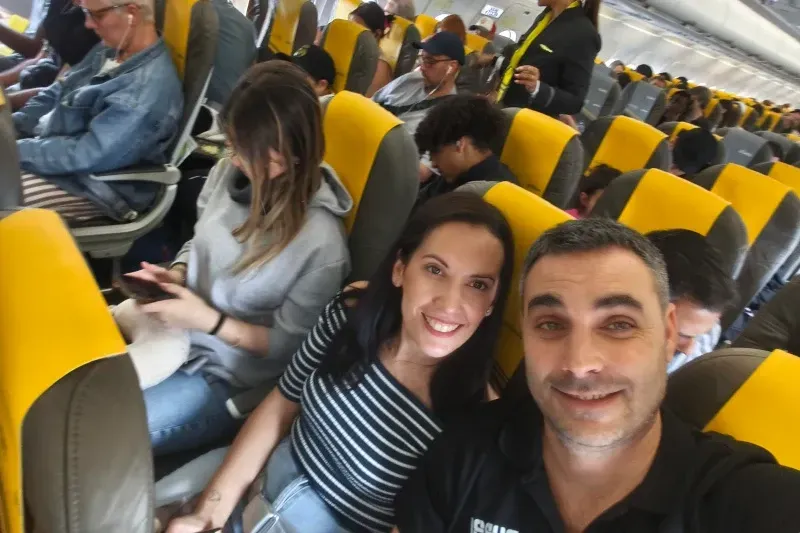
Mistakes when organizing arrival to Disneyland Paris from Spain
There comes a moment in planning a trip to Disneyland Paris when excitement starts to mingle with much less thrilling questions.
"What time should the flight depart?", "How much luggage will we need?", "How will we get from the airport?", "Will we arrive with energy or be eager to drop our bags and rest?".
These are practical questions, but they carry a lot of weight. An uncomfortable arrival doesn't ruin the trip, though it can change the tone with which the family experiences their first few hours.
From Spain, the journey doesn't begin at takeoff or end at landing. It includes leaving home, getting to the airport, going through security, waiting, flying, collecting luggage, and continuing to the accommodation. Logistics work like a chain: the more each step depends on the previous one going exactly as planned, the more fragile the whole operation becomes.
Organize it well it's not about eliminating every unforeseen event. It's about preventing a small delay from forcing you to improvise everything else.
Mistake 1: comparing flights by price alone
It's normal to start with the price. Transportation can represent a significant part of the budget, and it wouldn't make sense to ignore the differences between options.
The problem arises when the first number in the search engine is interpreted as the complete cost of arrival.
A seemingly economical flight may depart from an airport that requires adding a long transfer, parking, or a previous night's stay. It may also involve a difficult departure time for the family or baggage conditions that change the final price.

That doesn't make the cheap flight a bad choice. In many cases, it will still be the most reasonable option. The important thing is to know what it entails before booking it.
A family living near the airport and traveling with little luggage can manage a very early departure without too much difficulty. The same time can feel completely different if you have to wake up two children in the middle of the night, travel to another province, and manage several suitcases.
The useful comparison doesn't just pit two tickets against each other. It pits two full days against each other.
Mistake 2: calculating the trip based on flight duration
From the couch, the journey seems much shorter. We see the departure time, the arrival time, and feel that the rest will be small details.
In practice, those details add up.
The day begins when the family leaves home. You need to arrive with plenty of time to spare, manage luggage, go through security, and wait for boarding. After the flight, there's still disembarking, finding your way, collecting luggage, and continuing to your accommodation.
None of these steps seem particularly long on their own. Together, they can turn a short flight into a demanding travel day.
Planning improves when you differentiate between the ideal schedule and the realistic schedule. The former assumes everything works without deviations. The latter accepts that family travel requires time for bathroom breaks, snacks, attending to a child, or simply finding the correct exit without rushing.
There's no need to build the plan around the worst-case scenario imaginable. It's enough that arrival doesn't depend on every step being completed in the shortest possible time.
Mistake 3: booking a transfer with barely any wiggle room
After finding a flight, the temptation is usually to link it with the first available transfer option. It seems like the most efficient way to avoid waiting and get there as soon as possible.
However, the landing time doesn't indicate the exact moment the family will be ready to leave the airport.
Even when the plane arrives as scheduled, deplaning and baggage claim can prolong departure. Traveling with carry-on luggage only also doesn't guarantee the whole group will move at the same speed.
The official Disneyland Paris website presents different ways to get there from Paris airports, including shuttle services, public transport, taxis, and rental cars. The right alternative depends on the airport, schedule, accommodation, and group circumstances. Specific conditions should be reviewed before the trip.
Leaving room doesn't mean resigning yourself to hours of waiting. It means a small delay shouldn't force you to find a new solution while the family is tired and surrounded by luggage.
When children are traveling, that time also allows for regaining pace before starting another journey. Sometimes, the break that seemed unnecessary from home ends up being just what the group appreciates upon arrival.
Error 4: booking each piece without observing how it fits with the others
The internet makes it easy to book flights, transfers, and accommodation at different times. Each choice may seem reasonable on its own, yet still form an awkward combination.
Perhaps the budget flight arrives at a time when the preferred transfer option is no longer available. Maybe a simple option for two adults turns out to be much less practical with children, strollers, or multiple suitcases. It can also happen that the savings made on the flight disappear when adding up the travel from origin and destination.
Planning means looking at the entire chain.
It is not necessary to book all services together. The important thing is to check that the decisions support each other and that the family understands the real effort required by each combination.
An option with more changes might still be chosen because it fits the budget better. Another family will prefer to reduce travel even if they have to allocate a bit more to arrival. No decision is universally correct.
The difference lies in choosing with awareness of the consequences versus discovering them when the trip has already begun.
Mistake 5: Imagining arrival day as a full day
Excitement encourages making the most of every hour. If the plane lands in the afternoon, it's easy to start imagining everything that could still be done before the day ends. Reality is usually less precise.

Even if arrival goes smoothly, the family will have already gone through an early start, travel, waiting, changes of environment, and several small decisions. Children can be very excited and very tired at the same time, something that isn't always perceived until the first wait or the first change of plans appears.
Chispa Mágica's guide on Disneyland Paris with young children explains how fatigue and breaks affect family rhythm. Applied to arrival, the advice is simple: the first day should not depend on children maintaining the same energy they had when they left home.
You can prepare for a calm arrival and keep the option of adding something if everyone is feeling well. That flexibility usually feels much better than an agenda that forces you to keep going because "it was already planned."
Not filling up the first afternoon doesn't mean missing out on part of the trip. Sometimes, protecting the first night allows the experience to truly begin the next day.
Mistake 6: keeping all information with one person
In many families, there's one person who knows all the details. They have the tickets, know where the transfer is, have saved the address, and have access to confirmations.
While that person and their phone are available, the system seems convenient. Fragility appears when the battery runs out, the connection fails, or that person needs to attend to another situation.
There's no need to print a huge folder or distribute each reservation among everyone. It's enough for another adult to understand the itinerary and be able to access essential data.
The organization of confirmations, codes, and documents is already developed in the guide about documentation and reservations for Disneyland Paris. For arrival, the important thing is that a dead battery or a bad connection doesn't leave the family without the address, voucher, or transfer information.
Saving certain information offline and sharing it with another person reduces a mental load that usually falls on the same traveler.
Error 7: thinking an alternative plan complicates the trip more
Preparing an alternative doesn't mean imagining all possible problems or creating a document full of scenarios.
It means recognizing which part of the arrival has less margin and knowing where to look for a solution if it stops working.
It may be enough to know the official source of information, have the provider's data, and know what other transport categories exist. The family doesn't need to memorize routes or book two options. They just need to avoid the first setback forcing them to start searching from scratch.
The official Disneyland Paris information gathers the general possibilities for reaching the resort and should be consulted again before traveling, as services and their conditions may change.
A simple alternative plan does not eliminate spontaneity. It avoids making decisions when tired, with children waiting and luggage around.
How to make the arrival make sense as a whole
A comfortable arrival doesn't have to be the fastest, the most expensive, or the one with the fewest transfers. It has to make sense for those traveling.
If the flight departs early in the morning, perhaps the first afternoon will require a gentle pace. If the family is carrying a lot of luggage, every transition will feel heavier. If the transfer depends on a specific time, there should be enough margin to leave the airport without anxiety.
It is also worth asking who controls the information, what would happen if the connection fails, and how much actual time will pass from the moment the front door closes until everyone can rest.
These questions are not intended to complicate the preparation. They make visible what the initial flight search usually hides.
The best option may still be the most economical one. It could also be a slightly simpler combination that allows you to arrive with more energy. The important thing is that the family knows what they are choosing and why.
Logistics work best when they are barely remembered
After the trip, few people want to remember baggage claim or the journey from the airport. Precisely for this reason, it's worth taking care of that part.
A good arrival doesn't need to be special. It needs to be clear.
Everyone knows what happens after landing. There's enough buffer time. Information doesn't depend on a single phone. The family doesn't arrive with an impossible schedule for the first few hours.
When the logistics are well thought out, they fade into the background. Practical decisions stop taking up space, and the excitement returns to the center.
If you're starting to consider this adventure, you can continue exploring the options for trip to Disneyland Paris and compare the complete itinerary from Spain, not just the flight price. The destination page brings together general information and available planning possibilities.